Stop Hiring Humans (and the problem with AI industry's consequence-free culture)
Imposing billboards praising AI employees, “the artisans” [sic], over inefficient and outdated humans appeared in public spaces in San Francisco, New York City, and London, causing disbelief, outrage, anger — and a huge win in brand awareness and press coverage for the company behind it.
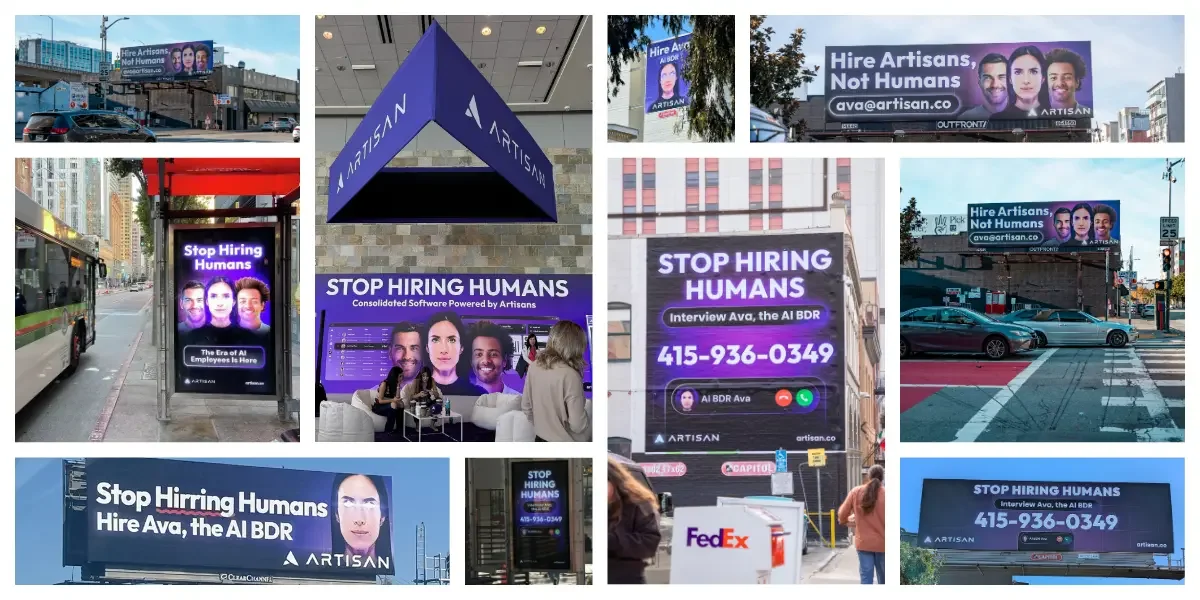
Source: Artisan
Artisan’s co-founder Jaspar Carmichael-Jack subsequently published a blog post, explaining their strategy.
He said: “the people who were mad aren’t our target audience. We target tech companies, and the vast majority of people who work at and run tech companies loved the campaign.”
And yet, it was regular people in the public spaces that were unanimously exposed to this hostile messaging.
People heading to their second and third jobs just to make ends meet.
People asking for a day off to care for a sick child, wondering if this is going to be the absence that gets them fired.
People feeling hopelessness after months of fruitless job applications, questioning their worth.
The campaign brings to mind the concept of “hostile architecture“, in which public space design intentionally deters vulnerable populations from finding comfort and shelter.
Of course, the psychological mechanism of most mainstream advertising relies on instilling feelings of lack and inferiority: pointing out what we don’t have, and luring with a promise of finally feeling complete after obtaining it.
But in this case, the average Artisan’s campaign viewer is not even the target customer. Instead, their anxiety, worry and outrage are mobilized to multiply the campaign’s reach - just as I’m doing now.
Another free article.
Another Google search result.
A goldmine of “user generated content” and free advertising.
The founder’s explanation attempts to position Artisan as an underdog: “a seed-stage” company in a “hypercompetitive market”, who has to resort to shock tactics in order to survive. Considering the $25M funding they’ve just secured, I’m not buying it. Peanuts for Silicon Valley standards, perhaps, but enough to create a power imbalance between the campaign masterminds, and an average passer-by exposed to it.
The campaign demonstrates Silicon Valley’s systemic disregard for human wellbeing, while claiming Promethean high ground and weaponizing “progress” to dismiss critics as luddites.
This is a culture that follows in the footsteps of the early Facebook’s “move fast and break things” motto. The culture of “any press is good press”. This is a culture in which men (who wouldn’t look out of place in an American Eagle ad) push ahead with a carefree buoyancy that privilege affords, convinced any wrongdoing can be fixed with polished appearance and a simple apology.
At the very end of his post, Carmichael-Jack softly walks back the campaign’s statement, saying: “The Truth Is, We Love Humans”. But, I am not holding my breath waiting for the day he pays for putting that on a billboard.
He goes on to say:
“We don’t actually want people to stop hiring humans - we’re actively hiring across all roles, and I don’t actually think AI is dystopian. The real goal for us is to automate the work that humans don’t enjoy, and to make every job more human.”
He continues:
“Inevitably as more and more human productivity is taken over by AI, we should first see a 4-day work week. Eventually, we should live in a world where everyone gets UBI, productivity is driven entirely by robots, we’re all free to do whatever we want and you can truly stop hiring humans, but today is not that day. In my opinion, that day will in fact be utopia.”
The problem with a company like Artisan, and the seemingly thoughtful statement above can be equated to the well-documented problem with fast fashion: a complete lack of product lifecycle responsibility.
Let’s take that trendy $10 Zara t-shirt. Naturally, the company uses extractive practices to produce the item at a cost this low. This process is hidden from the target customer: toxic dyes, cramped factories, merciless production quota at minimum wages. Only when the item hits the shelf, the marketing smokeshow will begin: strategically lit displays, glossy photoshoots, friendly cashiers.
But when the poor stitching comes apart a few weeks later, the waste becomes the customer’s problem.
Which becomes a local community’s problem.
Which, depending on circumstances, can become a drinking water quality problem, soil quality problem, air pollution problem. Or, in Western, affluent communities, it can be efficiently exported to become a problem of some global majority community — perhaps the very same one who produced the goods in the first place.
Taking full responsibility for the entire product lifecycle: fair wages in factories, financial and operational responsibility for product disposal, would likely make a $10 t-shirt, and the entire business model, unviable.
How does this relate to AI employees?
Carmichael-Jack attempts to soften his message by bringing up the 4-day work week and universal basic income are akin to social “greenwashing”.
Let’s imagine a different kind of utopia: one in which AI companies automating human labor take full responsibility for their product’s lifecycle.
This could look like:
Committing a portion of the profits to universal basic income, to be distributed in territories where the company operates — not just mentioning UBI in a blog post.
Actually reducing the company’s employees’ workweek to 4 days or less - not just talking about it as a nice idea that someone should implement one day.
Funding counseling, career coaching services, and education programs for people displaced by automation.
Funding friendly and supportive public community spaces for the unemployed to offset the hostile messaging.
Taking full responsibility for the environmental cost of running the “Artisans”: ensuring water and energy security for areas where their data centers are located, local regeneration and environmental protection programs to minimize impact.
Then, let’s consider again: is the AI automation business model still viable, and is the Artisan worker still a more cost-effective option?
I dare to suspect that, as they say: the math ain’t mathing.
Ultimately, my point of view is likely irrelevant to Jaspar Carmichael-Jack: I’m not his target audience, just like the hundreds of thousands of people encountering the “Stop hiring humans” billboards as they go about their day.
The campaign says:
“Artisans Won’t Complain About Work Life Balance”
“Artisans Won’t Come Into Work Hungover”
“Humans are so 2023”
Throwing people under a bus to appeal to corporate clients may be considered a simple business strategy, not targeted malice.
The cost of doing business? For every potential customer who “gets it”, thousands of unsuspecting passers-by hit with an emotional shrapnel of doubt, subtly eating away at their sense of relevance, amplifying uncertainty about the future — something they will just have to deal with by themselves.
But, let’s not forget that the Artisan founder’s future is uncertain, too: between 90-99% of AI companies are expected to fail.
So if the bully marketing tactics don’t pay off, Carmichael-Jack better keep one last “Artisan” around to hold his hand through it.
I worry he may struggle to find a supportive human target audience in a time of need.
Still reading? Subscribe to my Substack to get articles like this delivered directly to your inbox.
