Deadly Mistakes and Brutal Truths: The Subtle Violence of LinkedIn
Have you ever scrolled through LinkedIn, filled with inspiring, empowering, and upbeat content, only to end up feeling more uncertain and wired?
Starting my PhD research earlier this year led me to pay closer attention to how we communicate online: about the AI transition, and beyond. The more I observed LinkedIn from a researcher's perspective, the more uncomfortable I felt.
You may remember when research about Instagram's impact on teenage girls' wellbeing emerged. We were outraged but not entirely surprised.
Lately, we’ve watched LinkedIn pivot from a sleepy professional platform to an always-on, achievement-driven social network with over 1 billion users. Perhaps it’s a good moment to ask: what’s that discomfort underneath our collective professional enthusiasm?
I've come to call it "the subtle violence" of LinkedIn.
Deadly Mistakes and Brutal Truths
A LinkedIn post may start out like this:
"Keyword Cannibalization is Silently Killing Your Website Rankings!"
"Is confusion quietly killing your performance?"
"Slowness is killing your business."
An entrepreneur and investor serves up "9 brutal truths":
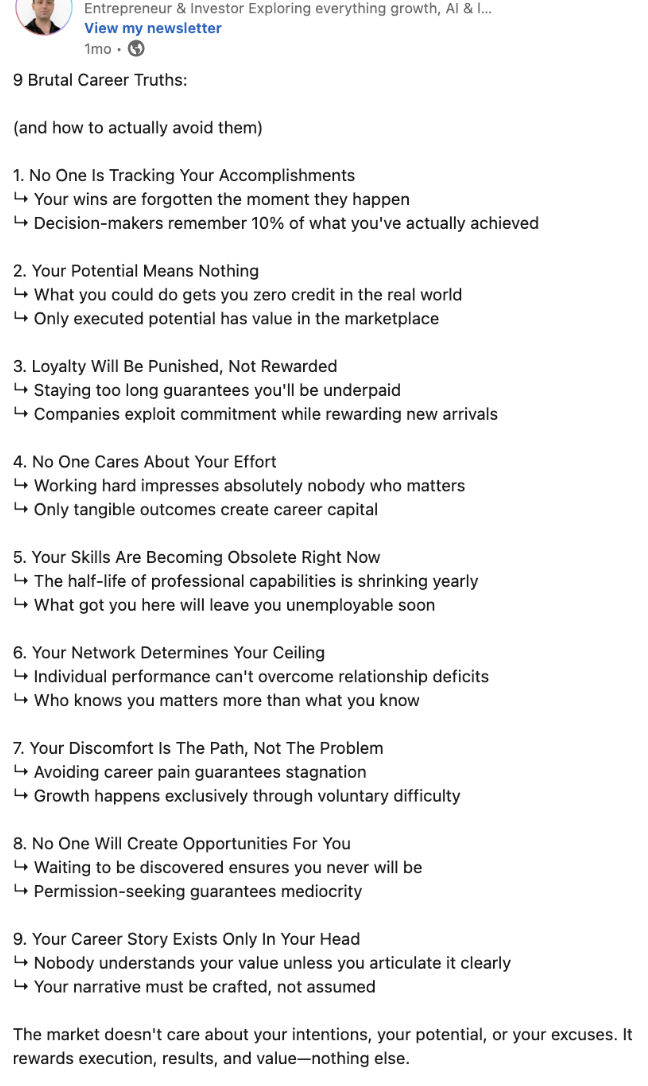
Source: LinkedIn
Are these truths? Perhaps.
But it's also a language of scarcity, anxiety, and linguistic violence.
It’s just a lot to take in while scrolling a professional networking platform with your morning coffee!
Even if the effect isn't conscious, your nervous system activates.
Muscles tense up.
Breath loses its depth.
Here's what I know to be true:
If that empowering thought leader were someone's boyfriend, spewing such nuggets of truth in person, a circle of girlfriends would stage an intervention to dump him!
A work colleague appearing at your desk to spontaneously proclaim your potential worthless could end up with an HR warning.
Somewhere along the line, the digital, professional interface creates an atmosphere of permissibility.
Adapt or Die
When it comes to AI, one of the hottest topics on LinkedIn, narratives centering fear of replacement and imperative of adaptation are omnipresent:
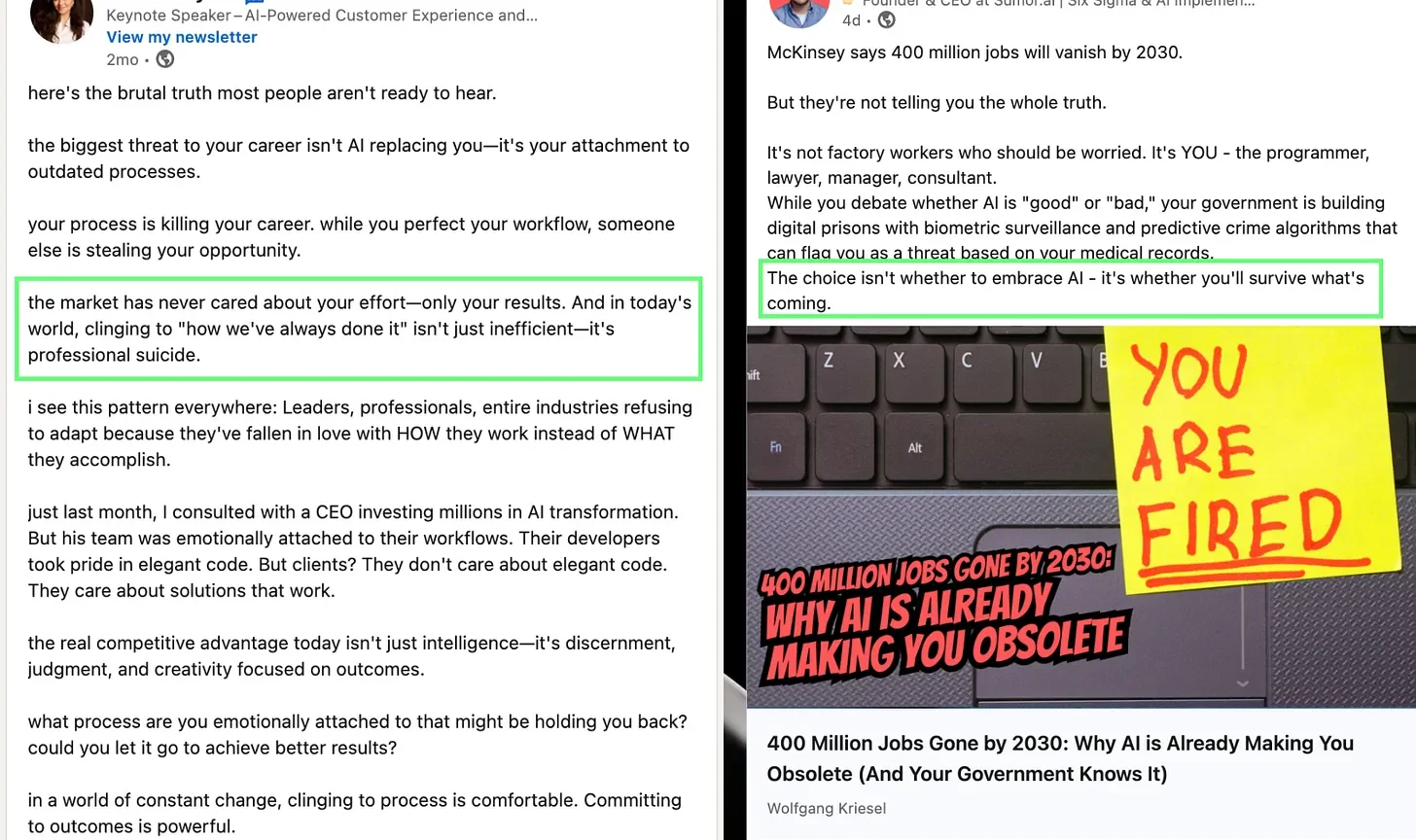
In a few short lines, we’ve been presented with a threat of death, robbery, and suicide!
These narratives go beyond just adapting to new tools or technology: they threaten total obsolescence. An existential demise.
The posts say:
Your fear of being replaced is irrational
But if you will be replaced, it’s because you failed to adapt
It’s difficult to disagree that the AI transition we’re experiencing is fast, disorienting, and simply unprecedented in its speed and scale.
And yet, the narratives we co-create leave no space for complex emotions, which would be a perfectly natural response: uncertainty, confusion, or even grief.
Instead, we’re caught up in language of shaming and blaming, putting the full responsibility on the individual.
In other words, on each other.
A Compulsive Kind of Freedom
What’s fascinating about the harsh tone of some posts is that most people aren’t paid by the employer to create such content, or even explicitly required to participate. On the face of it, LinkedIn is a community of professional peers, interacting voluntarily. Freely.
Philosopher Byung-Chul Han talks about a compulsive freedom in contemporary achievement society, in which an individual “gives itself over to compulsive freedom—that is, to the free constraint of maximizing achievement.”
He adds:
“Excess work and performance escalate into auto-exploitation. (...) The exploiter is simultaneously the exploited. Perpetrator and victim can no longer be distinguished. Such self-referentiality produces a paradoxical freedom that abruptly switches over into violence because of the compulsive structures dwelling within it.”
- The Burnout Society, Byung-Chul Han
It’s a web of mounting expectations, which many of us inadvertently impose on each other.
In addition to excelling at one’s job, remaining infinitely curious, motivated, and excited, there’s an implicit imperative to continuously assert this attitude online. Many workers face an exhausting conundrum of contradicting pressures:
To be visible
To be professional
To be authentic
To assert their expertise
But be real about the struggles
Without being too much of a downer!
Always finding a silver lining!
Conclude with a lesson to share
But avoid excessive bragging and smugness…
I could go on.
Some may say I’m overly negative, but I agree with Han, who claims the achievement society suffers from excess positivity: the compulsive always-on mentality leading to burnout. On that note, he diagnoses an interesting weakness of AI: its inability to pause.
“Contemplative inactivity, in particular, is alien to the machine. It knows only two states: on and off. Simply deactivating the machine does not bring about a contemplative state.”
-Vita Contemplativa: In Praise of Inactivity, Byung-Chul Han
In this insight, I believe, we may find a clue.
Rather than launching into proposing solutions, what I may offer instead is acknowledgement.
A moment to pause and admit: maybe the reason this feels overwhelming is… because it is.
Still reading? Subscribe to my Substack to get articles like this delivered directly to your inbox.
